
'Having analysed the break up of the hospital billing structure the committee believes that rationalising of room charges needs to be done on an emergent basis.'

At a time when the government is nudging the private sector to ramp up its capital expenditure (capex), the Ministry of Statistics and Programme Implementation (MoSPI) is poised to kick-start the first-of-its-kind annual survey on the status of private sector capex from next month. "The inaugural edition of the annual exercise will start in October and will be completed by December. "The results will be made public by February next year," said Geeta Singh Rathore, director general, National Sample Survey Office (NSSO), at a data users' conference on Thursday.

Ayush refers to the six Indian systems of medicines, namely Ayurveda, Yoga and Naturopathy, Unani, Siddha, Sowa-Rigpa and Homeopathy are majorly prevalent in the country.

India's unemployment rate reached an 11-month high of 5.5 per cent in May, up from 5.2 per cent in April, according to the National Statistics Office, indicating a softening labour market as labour-force participation also eased.

The number of people averse to the surveys by the National Statistical Office (NSO) has more than doubled over the last five years between the 75th National Sample Survey (NSS) round (July 2017- June 2018) and the 79th NSS round (July 2022-June 2023), the Ministry of Statistics and Programme Implementation MoSPI) said on Friday in a conference organised to discuss the issue of 'non- responsiveness' to its sample surveys. The ministry said that nearly 6.9 per cent people in urban areas surveyed by the NSO for the 79th NSS round did not participate in the exercise, while the number of people in rural India that refused to participate in these surveys stood at 3.9 per cent.

Rediff.com's data journalists have visualised the National Sample Survey Office (NSS 66th round, July 2009-June 2010 and 68th round, July 2011-June 2012) data into an interactive map.
Rediff.com's data journalists have visualised the National Sample Survey Office (NSS 68th round, July 2011-June 2012) data into a interactive map.
Rediff.com's data journalists have broken down the National Sample Survey Office 68 round (July 2011- June 2012) report data into a state-wise listing.

The map above shows the disparity in Monthly Consumer Expenditure as reported by the 68th round of National Sample Survey.
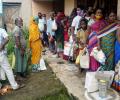
As the poverty rates in the country declined below 5 percent in 2024, a research study by State Bank of India also highlighted that the extreme poverty in the country has been reduced to minimal.
The drought of appropriate employment opportunities and rising incidences of unemployed educated graduates fail to inspire confidence about the future, says Kunal Kumar Kundu
Incredible though it may sound, only 2 out of every 100 person in the country is unemployed as against 10 out of 100 in the United States, according to a recent survey by a central government agency.
Real estate buying dropped between 2004 and 2012.
In the rural areas, 35.3 per cent of the workers are employed as casual labourers while the figure is 14.6 per cent in the urban areas.
Rediff.com's data journalists have broken down the National Sample Survey Office 68 round (July 2011- June 2012) report data into a state-wise listing.

About 7 crore (70 million) people in the country are either unemployed or under-employed, the National Sample Survey Office has said in its latest report.
Jaitley said the Budget proposals would boost the realty sector, which would help meet the housing needs of a vast section of the population.

As a well-wisher of the Indian Statistical System and part of the system for more than 37 years, Sunil K Sinha, former DG and CEO of NSSO, offers suggestions to improve data quality.

India's unemployed, the report said, were mostly those with higher education degrees and the young.

The minister said the international experience suggests that the inequalities tend to increase in the early phase of development.
The Planning Commission pegs decline at 7.8 percentage points between 2009-10 and 2011-12.

Unemployment rate for persons aged 15 years and above has remained unchanged at 3.2 per cent in July 2023 to June 2024, according to the labour force survey annual report released on Monday. The unemployment rate (UR) is defined as the percentage of persons unemployed among the persons in the labour force. The report stated that while the UR for male has shown a marginal decline from 3.3 per cent during July 2022 - June 2023 to 3.2 per per cent during July 2023 - June 2024, among female it has increased from 2.9 per cent to 3.2 per cent during the same time span.

Goa has the highest number of people who could 'search the Internet for information and can send or receive e-mails and can perform online banking transactions'.

The employment rate in the country declined marginally from 39.2 per cent to 38.6 per cent between 2009-10 and 2011-12, the Rajya Sabha was informed on Wednesday.
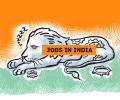
A government panel examined the records of employees surveyed by Labour Bureau's quarterly enterprises surveys and mapped it with the EPFO's subscribers and found "unexplained variations" between the two.

Rediff's data journalists bring you data about toilet/bathroom and sanitation facilities across India from the 69th round (2012) of National Sample Survey.
Buoyed by the robustness in rural job market on account of rabi sowing, India's monthly unemployment rate fell to an eight-month low of 4.7 per cent in November, the latest periodic labour force survey (PLFS) monthly bulletin released by the National Statistics Office (NSO) on Monday showed.
India's labour market in the second quarter (July-September/Q2) of 2025-26 (FY26) showed resilience, with the jobless rate easing even as more people entered the workforce. However, a rise in youth unemployment and a fall in the share of salaried workers remain areas of concern.

The next Census' findings will help identify the extent of India's ageing population and vulnerability levels.
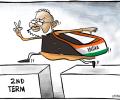
The government's decision to release the reports comes two days after over 200 scholars from across the globe issued a statement demanding release of all withheld reports produced by the NSO, including the household consumer expenditure survey that was junked.

'Unless the economy is sound in the country how can only three movies collected so much business in a single day?'

India's unemployment rate for persons aged 15 years and above was recorded at a six-year low of 3.2 per cent during July 2022-June 2023, as per the Periodic Labour Force Survey Annual Report 2022-2023 released by the National Sample Survey Office. Joblessness or unemployment rate is defined as the percentage of unemployed persons in the labour force. Considering the importance of the availability of labour force data at more frequent time intervals, the NSSO launched the Periodic Labour Force Survey (PLFS) in April 2017.
Labour markets showed positive momentum in August as the unemployment rate fell for the second consecutive month to a four-month low of 5.1 per cent from 5.2 per cent in July. It was on account of the start of the sowing season.

The technical report of the NSSO has generated controversy following its observation that as much as 36 per cent units forming part of MCA-21 database, used in computing GDP, could not be either identifiable or traceable in the field.

It said 33,510 slums were estimated to be in the urban areas of the country of which 41 per cent were notified.

After adding 11.7 million workers in the October 2022-September 2023 period from the pandemic lows in April 2021-March 2022, total workers employed in the vast informal sector in India - at 109.6 million - still remains below the pre-pandemic period.

This survey also shows how things have moved forward since the last large-scale sample survey conducted by NSSO in 2012-13

With the two members quitting, the NSC now has only two members -- Chief Statistician Pravin Srivastava and NITI Aayog CEO Amitabh Kant.
Niti Aayog vice-chairman Rajiv Kumar debunked claims of jobless growth, saying how can a country grow at an average of 7 per cent without employment.

While data can empower communities, it reinforces identities, making local politics more caste-centric, with decisions increasingly contested on the grounds of representation.
Such dynamics could lead to shifting alliances and, in the worst case, local governance getting paralysed as each group demands proportional power-sharing, explain Amitabh Kundu and Mehebub Rahaman.
